From the
Exploring Data website - http://curriculum.qed.qld.gov.au/kla/eda/
© Education Queensland, 1997
Galileo's Gravity and Motion Experiments
Over 400 years ago, Galileo conducted a series of experiments on the paths of projectiles, attempting to find a mathematical description of falling bodies. Two of his experiments are the basis of this assignment.
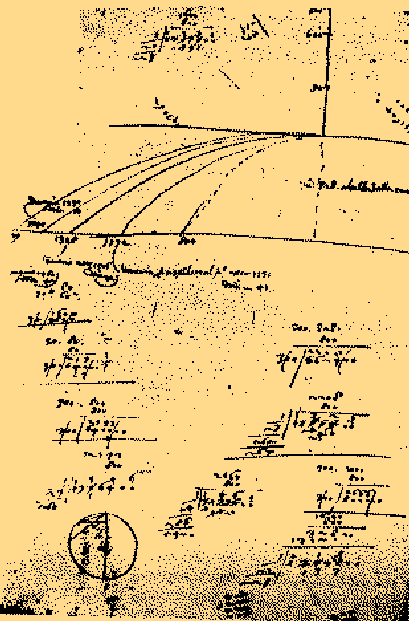
The experiments consisted of rolling a ball down a grooved ramp that was placed at a fixed height above the floor and inclined at a fixed angle to the horizontal. In one experiment the ball left the end of the ramp and descended to the floor. In a related experiment a horizontal shelf was placed at the end of the ramp, and the ball would travel along this shelf before descending to the floor. In each experiment Galileo altered the release height of the ball (h) and measured the distance (d) the ball travelled before landing. The units of measurement were called 'punti'. A page from Galileo's notes is shown below.
The data from these experiments is given in the following two tables.
Table 1 - Ramp Only
Release Height Above Table (h) |
Horizontal Distance (d) |
1000 |
573 |
800 |
534 |
600 |
495 |
450 |
451 |
300 |
395 |
200 |
337 |
100 |
253 |
Table 2 - Ramp and Shelf
Release Height Above Table (h) |
Horizontal Distance (d) |
1000 |
1500 |
828 |
1340 |
800 |
1328 |
650 |
1172 |
300 |
800 |
Source: Drake, S. (1978), Galileo at Work, Chicago: University of Chicago Press.
| Take Note of: Ockham's Razor: A maxim that whenever possible choose a simple model over a more complicated one. It just seems to be the way the world often works. |
1. Use the Ramp and Shelf data to find a mathematical model for the horizontal distance travelled as a function of release height. In particular:
a. Test at least two different mathematical models. Show any scatterplots and statistical analyses used in these tests.
b. Decide which mathematical model you feel best represents the data. Justify your decision.
c. Discuss how accurately your model fits the given data.
d. Would your mathematical model give sensible answers if the ball is released at greater heights? How well does your model work if the release height is 0?
2. According to Jeffreys
and Berger in an erratum to an article in American Scientist
(1992), the model for the Ramp Only data is of the form  where a and b
are parameters to be determined.
where a and b
are parameters to be determined.
a. The values of a and b can be found using a non-linear regression software program such as CurveExpert. Note that this program requires you to enter initial estimates for these parameters. You can find good initial estimates of the values of a and b by choosing two pairs of data from the Ramp Only data table, substituting into the above function and solving the resulting simultaneous equations.
b. Discuss how accurately your function fits the data.
c. What is the domain of d, given these values for a and b? What is the physical interpretation of this domain?
References
Dickey, D.A. and Arnold, J.T, (1995). Teaching Statistics with Data of Historic Significance: Galileo's Gravity and Motion Experiments, Journal of Statistics Education, v.3, n.1.
Drake, S. (1978). Galileo at Work, Chicago: University of Chicago Press.
Jeffreys, W. H., and Berger, J. O. (1992). Ockham's Razor and Bayesian Analysis, American Scientist, 80, 64-72 (Erratum, p. 116).