The objectives of this section is to
- understand and identify the patterns in number sequences.
You will have studied some sequences in earlier sections. Here we take these ideas further and meet some other types of sequences.
The first 4 triangular numbers are represented by the diagrams below:
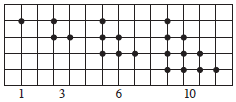
Draw the next 3 triangular numbers.
ShowNote that an extra row of dots is added to each triangle and that the extra row has one more dot than the previous row. The next 3 triangular numbers are shown below:
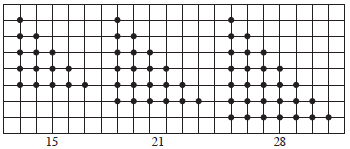
Describe how to find the 8th, 9th and 10th triangular numbers without drawing the diagrams.
ShowTo extend the sequence of triangular numbers, look at the difference between the terms:
| 1 | 3 | 6 | 10 | 15 | 21 | 28 | ||||||
 | | | | | | |||||||
| 2 | 3 | 4 | 5 | 6 | 7 |
Note that the difference between each term increases by 1 as you move along the sequence.
So,
| 8th term | = | 28 | + | 8 |
| = | 36 | |||
| 9th term | = | 36 | + | 9 |
| = | 45 | |||
| 10th term | = | 45 | + | 10 |
| = | 55 |
Write down the next 3 terms of the sequence:
3, 7, 10, 17, 27, 44, 71, ...
ShowLook at the differences between each term:
| 3 | 7 | 10 | 17 | 27 | 44 | 71 | ||||||
| | | | | | |||||||
| 4 | 3 | 7 | 10 | 17 | 27 |
The first difference is not very helpful, but then note how the sequence of differences is the same as the original sequence.
For example, 10 + 7 = 17
To find the next 5 terms:
| 8th term | = | 71 | + | 44 |
| = | 115 | |||
| 9th term | = | 115 | + | 71 |
| = | 186 | |||
| 10th term | = | 186 | + | 115 |
| = | 301 |
In this type of sequence, called a Fibonacci sequence, each term is the sum of the two previous terms. For example, this sequence begins:
3, 7, 10 where 3 + 7 = 10
and the next term is 10 + 7 = 17.
| Triangular Numbers | 1, | 3, | 6, | 10, | 15, | 21, | 28 | ... |
| Square Numbers | 1, | 4, | 9, | 16, | 25, | 36, | 49, | ... |
| Cubic Numbers | 1, | 8, | 27, | 64, | 125, | ... | ||
| Fibonacci Sequence | 1, | 1, | 2, | 3, | 5, | 8, | 13, | ... |
| (formed by adding the two previous terms to get the next one) | ||||||||