The objectives of this section are to
- understand and be able to determine the highest common factor (HCF) of 2 or more numbers
- understand and be able to determine the lowest common multiple (LCM) of 2 or more numbers
The factors of 12 are 1, 2, 3, 4, 6, 12.
The factors of 15 are 1, 3, 5, 15.
So the HCF of 12 and 15 is 3.
The HCF is easy to find for some numbers, but for others it is more difficult. In harder cases, the best way to find the HCF is to use prime factors.
For example, 18 is the smallest number that is a multiple of both 6 and 9, so the LCM of 6 and 9 is 18.
The LCM for larger numbers can be found by using prime factorisation.
Find the HCF of:
20 and 30
ShowThe factors of 20 are 1, 2, 4, 5, 10 and 20.
The factors of 30 are 1, 2, 3, 5, 6, 10, 15 and 30.
The HCF of 20 and 30 is 10.
14 and 12
ShowThe factors of 14 are 1, 2, 7 and 14.
The factors of 12 are 1, 2, 3, 4, 6 and 12.
The HCF of 14 and 12 is 2.
Find the HCF of 60 and 72.
Using factor trees:
| 60 | ||||
| 30 | 2 | |||
| 15 | 2 | |||
| 5 | 3 |
| 60 | = | 2 | × | 2 | × | 3 | × | 5 |
| = | 22 | × | 3 | × | 5 |
| 72 | |||||
| 36 | 2 | ||||
| 18 | 2 | ||||
| 9 | 2 | ||||
| 3 | 3 |
| 72 | = | 2 | × | 2 | × | 2 | × | 3 | × | 3 |
| = | 23 | × | 33 |
The HCF is calculated using the prime factors that are common to both numbers. In this case, 2 appears twice in both, and 3 appears once in both.
So,
| the HCF of 60 and 72 | = | 2 | × | 2 | × | 3 |
| = | 12 |
To be in the HCF, the prime factor must be in both lists:
| 60 | = | 2 | × | 2 | × | 3 | × | 5 | ||||
| 72 | = | 2 | × | 2 | × | 2 | × | 3 | × | 3 | ||
| HCF | = | 2 | × | 2 | × | 3 |
HCF = 12
Alternatively, using indices:
| 60 | = | 22 | × | 31 | × | 51 |
| 72 | = | 23 | × | 32 | × | 50 |
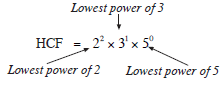
HCF = 12
What is the LCM of:
5 and 7
ShowThe multiples of 5 are:
5, 10, 15, 20, 25, 30, 35, 40, 45, ...
The multiples of 7 are:
7, 14, 21, 28, 35, 42, 49, ...
The LCM of 5 and 7 = 35.
6 and 10
ShowThe multiples of 6 are:
6, 12, 18, 24, 30, 36, 42, ...
The multiples of 10 are:
10, 20, 30, 40, 50, 60, ...
The LCM of 6 and 10 = 30.
Find the LCM of 60 and 72.
From Example 2,
60 = 2 × 2 × 3 × 5 = 22 × 3 × 5 and 72 = 2 × 2 × 2 × 3 × 3 = 23 × 32
The LCM includes all the factors from either number.
To be in the LCM, the prime factor can be in either list or in both lists:
| 60 | = | 2 | × | 2 | × | 3 | × | 5 | ||||
| 72 | = | 2 | × | 2 | × | 2 | × | 3 | × | 3 | ||
| LCM | = | 2 | × | 2 | × | 2 | × | 3 | × | 3 | × | 5 |
LCM = 360
Alternatively, using indices:
| 60 | = | 22 | × | 31 | × | 51 |
| 72 | = | 23 | × | 32 | × | 50 |
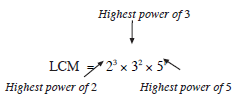
LCM = 360
Find the HCF and LCM of 50 and 70.
Using factor trees to find the prime factorisations:
| 50 | |||
| 25 | 2 | ||
| 5 | 5 |
| 50 | = | 2 | × | 5 | × | 5 |
| = | 21 | × | 52 |
| 70 | |||
| 7 | 10 | ||
| 2 | 5 |
| 70 | = | 2 | × | 5 | × | 7 |
| = | 21 | × | 51 | × | 71 |
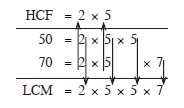
| HCF | = | 21 | × | 51 | × | 70 |
| = | 10 |
| LCM | = | 21 | × | 52 | × | 71 |
| = | 350 |