Angles and Turns
The objectives of this section are to
- recognise the relationship between turns and angles
- understand how to measure angles and how to work out their size in particular problems.
Angles are an important building block in geometry and trigonometry as you will see later. In this unit you will see how turns are related to angles, how to measure them and how to work out their size in particular problems.
You will need to understand clearly what the terms such as turn, half turn, etc. mean in terms of angles. There are 360 ° in one complete turn, so the following are true.

You also need to refer to compass points: (north (N), south (S), east (E), west (W), northeast (NE), southeast (SE), southwest (SW) and northwest (NW).
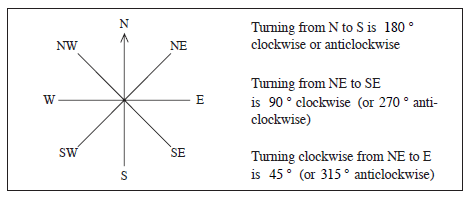
1
What angle do you turn through if you turn

(a)
from NE to NW anticlockwise,
Show You can see that this is 90° (or turn).(b)
from E to N clockwise?
Show This is a turn, i.e. 270°.