The objective of this section is to
- apply the formula for the volume of a triangular prism to determine the volume of a cylinder.
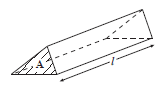
| Volume of prism | = area of cross-section × length |
| = Al |
A cylinder is a prism with a circular cross-section.
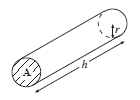
| Volume of cylinder | = A × h |
| = πr2h |
The total surface area of the cylinder can be determined by splitting it into 3 parts as below:
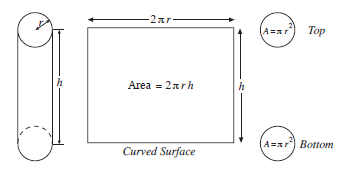
The curved surface can be opened out to form a rectangle. The length of one side is equal to the height, h, of the cylinder; the other is equal to the circumference of the cross-section, 2πr .
| Total area | = area of curved surface + area of top + area of bottom |
| = 2πrh + πr2 + πr2 | |
| = 2πrh + 2πr2 |
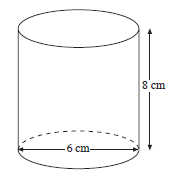
Calculate the volume and surface area of the cylinder shown in the diagram.
The radius of the base of the cylinder is 3 cm.
| Volume | = πr2h |
| = π × 32 × 8 | |
| = 226 cm3 (3 s.f.) |
| Surface area | = 2πrh + 2πr2 |
| = 2 × π × 3 × 8 + 2 × π × 32 | |
| = 207 cm2 (3 s.f.) |
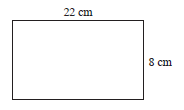
The diagram shows a sheet of card that is to be used to make the curved surface of a cylinder of height 8 cm.
Calculate the radius of the cylinder.
ShowThe circumference of the cross-section is 22 cm, so
| 2πr | = 22 |
| r | = |
| = | |
| = 3.50 cm (3 s.f.) |
Use your answer to part (a) to calculate the area of card that would be needed to make ends for the cylinder.
Show| Area of ends | = 2 × πr2 |
| = 2 × π × 3.502 | |
| = 77.0 cm2 (3 s.f.) |
Calculate the volume of the cylinder.
Show| Volume of cylinder | = πr2h |
| = π × 3.52 × 8 | |
| = 308 cm3 (3 s.f.) |