Distance-Time Graphs

The objective of this section is to

Graphs that show distance against time can be used to describe journeys. The vertical scale shows the distance from the starting point or reference point.

The graph above illustrates 3 parts of a journey.
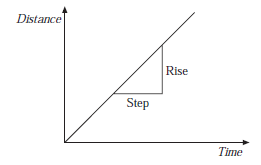
The gradient of a straight line gives the speed of the moving object.

Gradient is a measure of the speed.

Note that a negative gradient indicates that the object is moving towards the starting point rather than away from it.

1

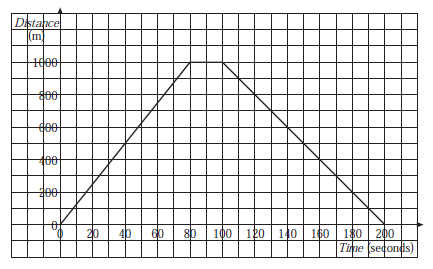
The graph shows how far a child is from home.
(a)

Describe how the child moves.

Show

The first part of the graph shows the child moving away from home at a constant speed.

The second (horizontal) part of the graph shows that the child remains in the same position.

The third part of the graph shows the child returning to the starting point at a steady speed.

(b)

Calculate the speed of the child on each part of the journey.

Show

During the first stage the child travels 1000 m in 80 seconds.

Speed =
=
= 12.5 m/s

During the second stage the speed of the child is zero.

During the third stage as the child returns, he travels 1000 m in 100 seconds.

Speed =
=
= 10 m/s
2

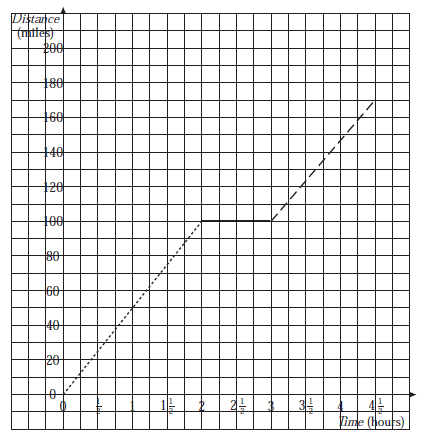
On a journey, Rebecca drives at 50 mph for 2 hours, rests for 1 hour and then drives another 70 miles in hours.

Draw a distance-time graph to illustrate this journey.
Show

First stage
Travels 100 miles in 2 hours.

Second stage
Rests, so distance does not change.

Third stage
Travels 70 miles in hours.

3

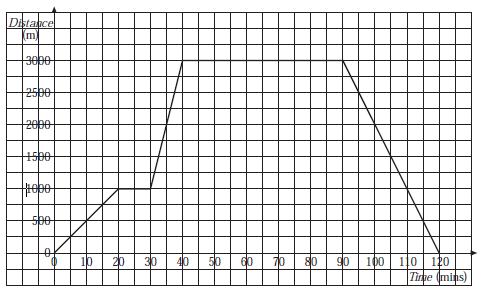
The graph shows how Tom's distance from home varies with time, when he visits Ian.
(a)

How long does Tom spend at Ian's?

Show

The longer horizontal part of the graph represents the time that Tom is at Ian's.

Time = 90 − 40
= 50 minutes
(b)

How far is it from Tom's home to Ian's?

Show 3000 m
(c)

For how long does Tom stop on the way to Ian's?

Show Tom stops for 10 minutes, represented by the smaller horizontal part on the graph.
(d)

On which part of the journey does Tom travel the fastest?

Show

He travels fastest on the second part of the journey to Ian's. This is where the graph is steepest. He travels 2000 m in 10 minutes.

Speed =
= 200 m/minute
=
= 12 km/h
(e)

How fast does Tom walk on the way back from Ian's?

Show

Tom travels 3000 m in 30 mins.

Speed =
=
= 100 m/minute

The following graph illustrates how Jamar moves as he goes to the paper shop:

(a)

How long does it take Jamil to cycle to the shop?

min
(b)

What distance does Jamil cycle to get to the shop?

m
(c)

Calculate the speed at which Jamil cycles to the shop.

m/s
(d)

How long does Jamil spend at the shop?

min
(e)

Calculate the speed at which Jamil cycles on his way home.

m/s

Describe the 5 parts of the journey (labelled (a), (b), (c), (d) and (e)) represented by the following distance-time graph:

(a)
km/h for hr(s)
(b)
km/h for hr(s)
(c)
km/h for hr(s)
(d)
km/h for hr(s)
(e)
km/h for hr(s)

Radd walks 420 m from his house to a shop in 7 minutes. He spends 5 minutes at the shop and then walks home in 6 minutes.

Draw a distance-time graph for Radd's shopping trip.

Calculate, in m per minute, the speed at which Radd walks on each part of the journey

Radd walks to the shop at m/minute and walks home at m/minute.

Mary sprints 200 m in 30 seconds, rests for 45 seconds and then walks back in minutes to where she started the race.

Draw a distance-time graph for Mary.

(a)

Calculate, in m/s, the speed at which Mary sprints.

m/s (to 2 d.p.)
(b)

Calculate, in m/s, the speed at which Mary walks.

m/s (to 2 d.p.)

After morning school, Mike walks home from school to have his lunch. The distance-time graph below describes his journey on one day, showing his distance from home

(a)

How far is Mike's home from school?

m
(b)

How long does it take Mike to walk home?

mins
(c)

At what speed does he walk on the way home? Give your answer in m/s.

m/s (to 2 d.p.)
(d)

How long does Mike spend at home?

mins
(e)

At what speed does he walk back to school? Give your answer in m/s.

m/s

Helen cycles for 20 minutes at 5 m/s and then for a further 10 minutes at 4 m/s.

How far does she cycle altogether?

Draw a distance-time graph for her ride.

m

The distance-time graph is for a 3000 m cross-country race, run by Rachel and James.

(a)

Describe how James runs the race.

Constant speed m/min
(b)

Describe how Rachel runs the race.

m/min for mins

m/min for next 25 mins

m/min for next mins

(c)

When, and how far from the start, does James catch up with Rachel?

mins into race at m
(d)

Who wins the race?

Josh completes a 10000 m race. He runs the first 2000 m at 5 m/s, the next 7400 m at 4 m/s and the last 600 m at 6 m/s.

Draw a distance-time graph for Josh's race.

How long does he take to complete the race?

mins (2 d.p.)

Emma runs a 2000 m race. She runs at 5 m/s for the first part of the race and at 4 m/s for the rest of the race. She complete the race in 440 seconds.

Draw a distance-time graph for Emma's race.

How far does she run at each speed?

m at 5 m/s

m at 4 m/s