

The number system is classified into various categories.
Natural numbers (or 'counting numbers')
These are the positive whole numbers, namely 1, 2, 3, ...
Integers
These are the set of positive and negative whole numbers, e.g. 1, 10, 364, –7, –102.
The set of integers is denoted by Z.
Rational Numbers
A rational number is a number which can be written in the form
, where m and n are integers.
For example, is a rational number. A rational number is in its simplest form if m and n have no common factor and n is positive. The set of rational numbers is denoted by Q.
Irrational Numbers
There are numbers which cannot be written in the form
, where m and n are integers.
Examples of irrational numbers are π, , , .
Terminating Decimals
These are decimal numbers which stop after a certain number of decimal places.
For example,
= 0.875
is a terminating decimal because it stops (terminates) after 3 decimal places.
Recurring Decimals
These are decimal numbers which keep repeating a digit or group of digits; for example
= 0.528 957 528 957 528 957 ....
is a recurring decimal. The six digits 528957 repeat in this order. Recurring decimals are written with dots over the first and last digit of the repeating digits, e.g. 0.528 957
Note
All terminating and recurring decimals can be written in the form , so they are rational numbers.Real Numbers
These are made up of all possible rational and irrational numbers; the set of real numbers is denoted by R.
We can use a Venn diagram to illustrate this classification of number, as shown here.

Some numbers have been inserted to illustrate each set.
Worked Examples
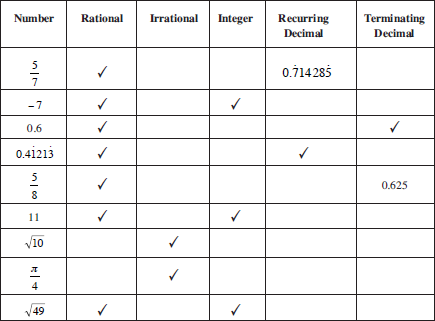
Classify the following numbers as integers, rational, irrational, recurring decimals, terminating decimals.
, −7, 0.6, 0.41213, , 11, , ,

Show that the numbers 0.345 and 0.0917 are rational.
For a terminating decimal the proof is straightforward.
0.345 = =
which is rational because m = 69 and n = 200 are integers.
For a recurring decimal, we multiply by a power of ten so that after the decimal point we have only the repeating digits.
| 0.0917 × 10 000 | = 917.917 917 917 ... | |
| Also | 0.0917 × 10 | = 0.917 917 917 ... |
Subtracting the second equation from the first gives
| 0.0917 × 10 000 − 0.0917 × 10 | = 917 |
| 0.0917 × (10000 − 10) | = 917 |
| 0.0917 | = |
which is rational because m = 917 and n = 9990 .
Prove that is irrational.
Assume that is rational so we can find integers m and n such that = , and m and n have no common factors. Square both sides,
3 =
Multiply both sides by n2 ,
m2 = 3n2
Since 3n2 is divisible by 3, then m2 is divisible by 3.
Since m is an integer, m2 is an integer and 3 is prime, then m must be divisible by 3.
Let m = 3p, where p is an integer.
| 3n2 | = m2 = (3p)2 = 9p2 | |
| ⇒ | n2 | = 3p2 |
Since 3p2 is divisible by 3, n2 is divisible by 3 and hence n is divisible by 3. We have shown that m and n are both divisible by 3. This contradicts the original assumption that = , where m and n are integers with no factor common. Our original assumption is wrong. is not rational – it is irrational.
Exercises
