


The net of a cube can be used to find its surface area.
The net is made up of 6 squares, so the surface area will be 6 times the area of one square. If x is the length of the sides of the cube its surface area will be 6x2.
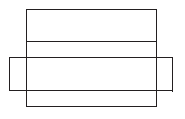
This diagram shows the net for a cuboid. To find the surface area the area of each of the 6 rectangles must be found and then added to give the total.
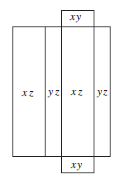
If x, y and z are the lengths of the sides of the cuboid, then the area of the rectangles in the net are as shown here.
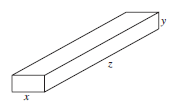
The total surface area of the cuboid is then given by
To find the surface area of a cylinder, consider how a cylinder can be broken up into three parts, the top, bottom and curved surface.
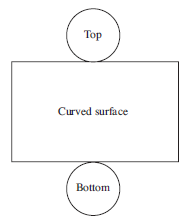
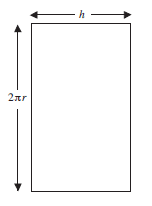
The areas of the top and bottom are the same and each is given by πr2.
The curved surface is a rectangle. The length of one side is the same as the circumference of the circles, 2πr, and the other side is simply the height of the cylinder, h. So the area is 2πrh.
The total surface area of the cylinder is
Another important result is the surface area of a sphere.

For a sphere with radius r, the surface area is given by the formula
Worked Examples

Find the surface area of the cuboid shown in the diagram.

The diagram shows the net of the cuboid and the areas of the rectangles that it contains.
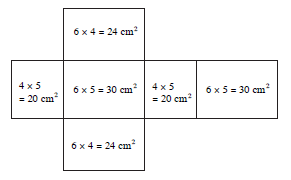
Using the net, the total surface area is given by
| A | = 2 × 20 + 2 × 30 + 2 × 24 |
| = 148 cm² |
Cans are made out of aluminium sheets, and are cylinders of radius 3 cm and height 10 cm. Find the area of aluminium needed to make one can.

The diagram shows the two circles and the rectangle from which cans will be made.
The rectangle has one side as 10 cm, the height of the cylinder and the other side is 2 × π × 3 cm, the circumference of the top and bottom.
The area of the rectangle is 10 × 2 × π × 3 The area of each circle is π × 32
| So the total surface area is | A | = 10 × 2 × π × 3 + 2 × π × 32 |
| = 245.04 cm² (to 2 d.p.) |
A ball has radius 4 cm. What is its surface area, to the nearest cm²?
| Surface area | = 4πr2 cm² |
| = 4π42 cm² | |
| = 64π cm² | |
| = 201 cm² to the nearest cm² |
Note
There is a formula for calculating the surface area of a cone:
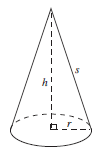
where
s = slant height of the cone
r = radius of the base
(and s2 = h2 + r2, where h is the perpendicular height of the cone).
What is the surface area of a cone of base radius 5 cm and perpendicular height 12 cm?
Give your answer in terms of π.
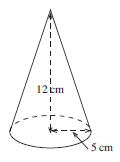
| Slant height | = |
| = | |
| = | |
| = 13 cm | |
| Surface area | = (π × 5 × 13 + π × 52) cm2 |
| = (65π + 25π) cm2 | |
| = 90π cm2 |
Note
There is also a formula for calculating the surface area of a square-based pyramid:
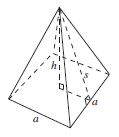
where
s = perpendicular slant height of the pyramid
a = length of the side of the square base
(and h is the perpendicular height of the pyramid).
Note that a2 is the surface area of the base and each trianglar face has area as.
What is the surface area of a square-based pyramid of base side 6 cm and height 4 cm?
We first calculate the slant height from
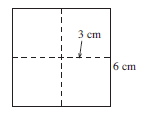
| s2 | = h2 + 32 |
| = 42 + 32 | |
| = 16 + 9 | |
| s2 | = 25 ⇒ s = 5 cm |
Hence,
| surface area | = (2 × 6 × 5 + 62) cm2 |
| = (60 + 36) cm2 | |
| = 96 cm2 |
Exercises
