Text
Unit F2 Section 1
Compass Bearings

When describing a direction, the points of a compass can be useful, e.g. S (south) or SW (south west).
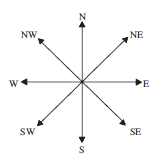
A bearing can also be used, often in navigation and by people walking on rough or open moorland or hills.

Note

Bearings are always measured clockwise from north and use 3 digits.
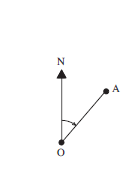
The bearing of A from O is 050° .
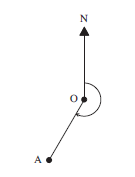
The bearing of A from O is 210° .

Worked Examples

1

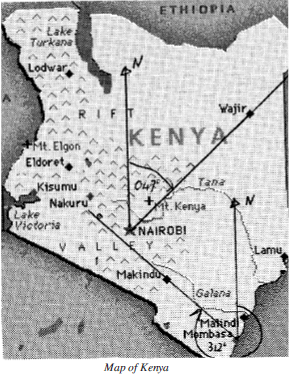
On a map of Kenya, find the bearings of
(a)

Wajir from Nairobi

First draw in a north line at Nairobi and another line from Nairobi to Wajir.

Then measure the angle clockwise from north to the second line. In this case the angle is 47° so the bearing is 047°.

(b)

Makindu from Mombasa.

Draw a north line at Mombassa and a line from Mombassa to Makindu. The bearing can then be measured as 312°.

2

A boat sails for 500 miles on a bearing of 070° and then sails a further 700 nautical miles on a bearing of 200° . Find the distance of the boat from its starting point and the bearing that would have taken it straight there.
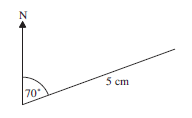
To find the solution use a scale drawing.
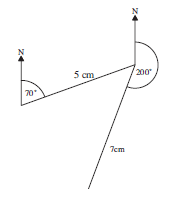
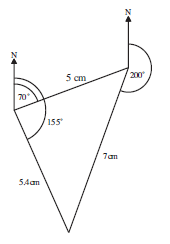
1.
Draw a north arrow at the starting point.
2.
Measure an angle of 70° from North.
3.
Draw a line 5 cm long. (1 cm represents 100 nautical miles.)
4.
Draw a second north arrow and measure an angle of 200° .
5.
Draw a line 7 cm long.
6.
Join the final point to the starting point and measure the distance.


It is 5.4 cm, which represents 540 nautical miles.


7.
The bearing can also be measured as 155° .
3

A ship leaves port P and sails to port Q on a bearing of 124°. From Q, the ship travels to port R on a bearing of 320°.

Given that the bearing of R from P is 025° :

(a)

Draw a carefully labelled diagram to represent the journey of the ship.

(b)

Determine the bearing of P from R.

Bearing of P from R is

180° + 025° = 205°

Bearings are used again in section 4 of Unit 34, when you calculate distances between points.

Exercises

The diagram shows the positions of 8 friends.

(a)

Who is directly south of Riah?

(b)

If Kaneila walks SE, whom will she meet?

(c)

If Riah walks SW, whom will she meet?

(d)

Who is directly west of Krista?

(e)

Who is NW of Krista?

(f)

Who will Shavon meet if he walks NW?

(g)

In what direction should Shamoy walk to find Riah?

The map shows some towns and cities in the Wales.

Write down the bearing of each of the following places from Mount Snowdon.

(a)
Llangollen °
(b)
Newport °
(c)
Swansea °
(d)
Bangor °
(e)
Milford Haven °
(f)
Aberystwyth °

In order to avoid an area of dangerous rocks a yacht sails as shown in the diagram.

Find the bearing of the yacht as it sails from

(a)
A to B °
(b)
B to C °
(c)
C to D. °

Use a scale drawing to find the answers to each of the following problems.

(a)

If a man walks 700 m on a bearing of 040° , how far north and how far east is he from his starting point?

m North, m East
(b)

A dog runs 50 m on a bearing of 230° and then runs north until he is west of his starting point. How far is the dog from its starting point?

m
(c)

A helicopter flies 80 km north and then 20 km SW. What bearing would have taken the helicopter directly to its final position?

How far is the helicopter from its starting point?

°, km
(d)

A boat travels 500 m NE and then 500 m south. What bearing would take the boat back to its starting point?

°
(e)

A plane flies 300 km west and then a further 200 km SW. It then returns directly to its starting point.

On what bearing should it fly and how far does it have to travel?

°, m

A ship sails from a point A to another point B, 8000 m due east of A.

It then sails in another direction and arrives at a point C, 10 000 m SE of A.

On what bearing did the ship sail on the second stage of the journey and how far did it travel?

°, km

The diagram shows the position of three places, A, B and C. AB is the same length as AC.

(a)
(i)

Calculate the size of the angle marked x.

°
(ii)

Calculate the size of the angle marked z.

°
(b)

Use your answers to (a) to calculate the bearing of

(i)
C from A °
(ii)
A from B °
(iii)
B from C. °

Investigation

Draw a rectangle of any size. Use your ruler to locate the mid-points of the sides. Join these mid-points to form a new quadrilateral.

What is the name of the quadrilateral you have obtained?

Repeat the above by drawing

(a) a trapezium

(b) a parallelogram

(c) a kite

(d) a rhombus

(e) a quadrilateral of 4 unequal lengths.

What conclusion can you draw from these?