

Similar shapes have the same shape but may be different sizes. The two rectangles shown below are similar – they have the same shape but one is smaller than the other.
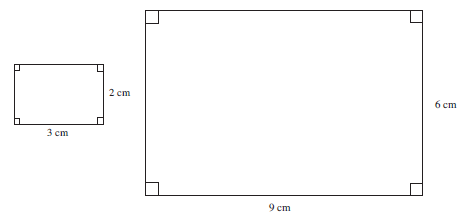
They are similar because they are both rectangles and the sides of the larger rectangle are three times longer than the sides of the smaller rectangle.
It is interesting to compare the area of the two rectangles. The area of the smaller rectangle is 6 cm2 and the area of the larger rectangle is 54 cm2 , which is nine times (32) greater.
Note
In general, if the lengths of the sides of a shape are increased by a factor k, then the area is increased by a factor k2.

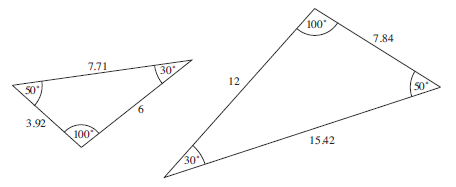
These two triangles are not similar.
The sides lengths of the triangles are not in the same ratio and so the triangles are not similar.
For two triangles to be similar, they must have the same internal angles, as shown in the similar shapes below.
The diagrams below show 3 similar cubes.

| Length of side | Area of one face | Surface area | Volume |
| 1 cm | 1 cm2 | 6 cm2 | 1 cm3 |
| 2 cm | 4 cm2 | 24 cm2 | 8 cm3 |
| 3 cm | 9 cm2 | 54 cm2 | 27 cm3 |
The table gives the lengths of sides, area of one face, total surface area and volume.
Comparing the larger cube with the 1 cm cube we can note that:
| For the 2 cm cube | |||||
| The lengths are | 2 | times greater. | |||
| The areas are | 4 | = | 22 | times greater. | |
| The volume is | 8 | = | 23 | times greater. | |
| For the 3 cm cube | |||||
| The lengths are | 3 | times greater. | |||
| The areas are | 9 | = | 32 | times greater. | |
| The volume is | 27 | = | 33 | times greater. |
Note
If the lengths of a solid are increased by a factor, k, its surface area will increase by a factor k2 and its volume will increase by a factor k3 .
Worked Examples
Which of the triangles, A, B, C, D, shown below are similar?


First compare triangles A and B.
Here all the lengths of the sides are twice the length of the sides of triangle A, so the two triangles are similar.
Then compare triangles A and C.
Here all the angles are the same in both triangles, so the triangles must be similar.
Finally, compare triangles A and D.
Note that 4 = × 8 and 4.52 = × 9.04, but 3.5 ≠ × 6.13.
So these triangles are not similar.
How do the areas of the triangles which are similar compare?
The lengths of the sides of triangle B are 2 times greater than the lengths of the sides of triangle A, so the area will be 22 = 4 times greater.
The side lengths of triangle C are 3 4 of the side lengths of triangle A.
So the area will be ⎛
⎝⎞
⎠2 =
of the area of triangle A.
The ratio of the areas of triangles C : A : B can be written as:
: 1 : 4
or
9 : 16 : 64

Explain why triangles ABE and ACD are similar.
As the lines BE and CD are parallel,
∠ABE = ∠ACD
and
∠AEB = ∠ADC
As the vertex A, is common to both triangles,
∠DAC = ∠EAB
So the three angles are the same in both triangles and therefore they are similar.
Find the lengths of x and y.
Comparing the sides BE and CD, the lengths in the larger triangle are 1.5 times the lengths in the smaller triangle. Alternatively, it can be stated that the ratio of the lengths is 2 : 3.
So the length AC will be 1.5 times the length AB.
| AC | = 1.5 × 6 | |
| = 9 | ||
| So | y | = 3 |
In the same way,
| AD | = 1.5 × AE, | |
| so | 4 + x | = 1.5x |
| 4 | = 0.5x | |
| x | = 8 |
Find the ratio of the area of ABE to BCDE.
As the lengths are increased by a factor of 1.5 or for the larger triangle, the
areas will be increased by a factor of 1.52 or ⎛
⎝⎞
⎠2.
We can say that the ratio of the areas of the triangles is
If the area of triangle ABE is 4k, then the area of triangle ACD is 9k and hence the area of the quadrilateral BCDE is 5k.
So the ratio of the area of ABE to BCDE is 4 : 5.
The diagrams show two similar triangles.

If the area of triangle DEF is 26.46 cm2, find the lengths of its sides.
If the lengths of the sides of triangle DEF are a factor k greater than the lengths of the sides of triangle ABC, then its area will be a factor k2 greater than the area of ABC.
| Area of ABC | = × 4 × 3 | |
| = 6 cm2 . | ||
| So | 6 × k2 | = 26.46 |
| k2 | = 4.41 | |
| k | = | |
| = 2.1 |
So the lengths of the sides of triangle DEF will be 2.1 times greater than the lengths of the sides of triangle ABC.
| DE | = 2.1 × 5 | |
| = 10.5 cm | ||
| DF | = 2.1 × 3 | |
| = 6.3 cm | ||
| EF | = 2.1 × 4 | |
| = 8.2 cm |
A can has a height of 10 cm and has a volume of 200 cm3. A can with a similar shape has a height of 12 cm.
Find the volume of the larger can.
The lengths are increased by a factor of 1.2, so the volume will be increased by a factor of 1.23.
| Volume | = 200 × 1.23 |
| = 345.6 cm3 |
Find the height of a similar can with a volume of 675 cm3 .
If the lengths are increased by a factor of k, then the volume will be increased by k3.
| 675 | = 200 × k3 |
| k3 | = 3.375 |
| k | = |
| = 1.5 |
So the height must be increased by a factor of 1.5, to give
| height | = 1.5 × 10 |
| = 15 cm |
Exercises
