

Coordinates are pairs of numbers that uniquely describe a position on a rectangular grid. The system was invented by the 17th century French mathematician, René Descartes. These numbers are sometimes referred to as Cartesian coordinates.
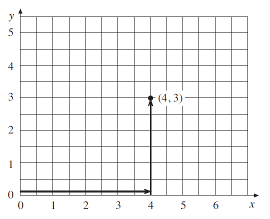
The first number refers to the horizontal (x-axis) and the second the vertical (y-axis). The coordinates (4, 3) describe a point that is 4 units across and 3 units up on a grid from the origin (0, 0).
Worked Examples
Plot the points with coordinates
(3, 8), (6, 1) and (2, 5)

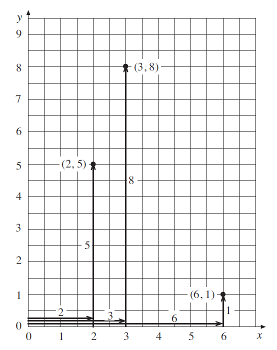
For (3, 8) move 3 across and 8 up.
For (6, 1) move 6 across and 1 up.
For (2, 5) move 2 across and 5 up.
Write down the coordinates of each point in the diagram below.
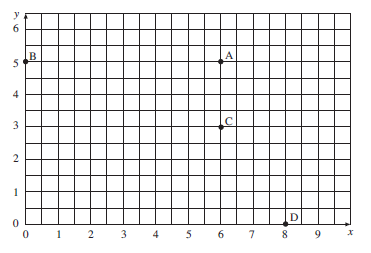
A is 6 across and 5 up, so the coordinates are (6, 5).
B has no movement across and is straight up 5, so the coordinates are (0, 5).
C is 6 across and 3 up, so the coordinates are (6, 3).
D is 8 across and no movement up, so the coordinates are (8, 0).
Exercises
