

Text
Unit F6 Section 2
Rotations
Rotations are obtained when a shape is rotated about a fixed point, called the centre of rotation, through a specified angle. The diagram shows a number of rotations.
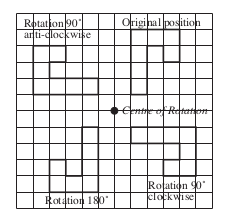
It is often helpful to use tracing paper to find the position of a shape after a rotation.
Worked Examples
1
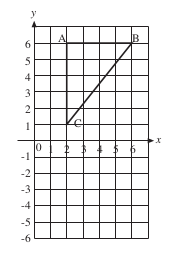
Rotate the triangle ABC shown in the diagram through 90° clockwise about the point with coordinates (0, 0).

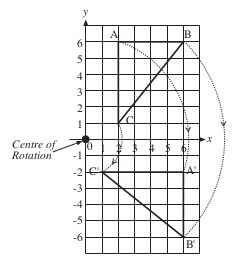
The diagram opposite shows how each vertex can be rotated through 90° to give the position of the new triangle.
2
The diagram shows the position of a shape A and the shapes, B, C, D, E and F which are obtained from A by rotation.
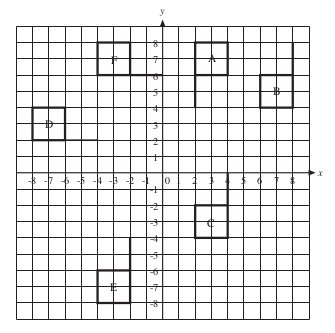
Describe the rotation which moves A onto each other shape.
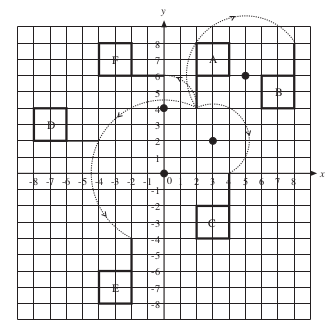
Each rotation is now described.
| • A to B: | Rotation of | 180° | about the point (5, 6). |
| • A to C: | Rotation of | 180° | about the point (3, 2). |
| • A to D: | Rotation of | 90° | anti-clockwise about the point (0, 0). |
| • A to E: | Rotation of | 180° | about the point (0, 0). |
| • A to F: | Rotation of | 90° | anti-clockwise about the point (0, 4). |
Exercises
