

Pythagoras' Theorem gives a relationship between the lengths of the sides of a right angled triangle.
Pythagoras' Theorem states that:
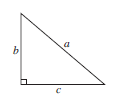
For the triangle shown opossite,
Note
The longest side of a right angled triangle is called the hypotenuse.
Proof
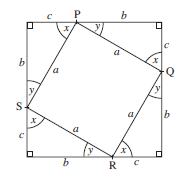
Draw a square of side b + c , as shown opposite. Join up the points PQ, QR, RS, SP as shown, to give a quadrilateral, PQRS.
In fact, PQRS is a square as each side is equal to a (as the four triangles are congruent) and at the point P,
x + angle SPQ + y = 180°
But we know that x + y = 90° , so
angle SPQ = 90°
Similarly for the other three angles in PQRS. Thus PQRS is a square, and equating areas,
a^2 + 4 × ⎛
⎝bc⎞
⎠ = (b + c)^2
a^2 + 2bc = b^2 + 2bc + c^2
Hence
Worked Examples
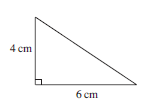
Find the length of the hypotenuse of the triangle shown in the diagram. Give your answer correct to 2 decimal places.

As this is a right angled triangle, Pythagoras' Theorem can be used. If the length of the hypotenuse is a, then b = 4 and c = 6.
So
| a2 | = b^2 + c^2 | |
| a2 | = 4^2 + 6^2 | |
| a2 | = 16 + 36 | |
| a2 | = 52 | |
| a | = | |
| = 7.2 cm | (to one decimal place) |

Find the length of the side of the triangle marked x in the diagram.
As this is a right angled triangle, Pythagoras' Theorem can be used. Here the length of the hypotenuse is 6 cm, so writing a = 6 cm and c = 3 cm with b = x , we have
| a2 | = b^2 + c^2 | |
| 62 | = x^2 + 3^2 | |
| 36 | = x^2 + 9 | |
| 36 − 9 | = x^2 | |
| 27 | = x^2 | |
| = x | ||
| x | = 5.2 cm | (to one decimal place) |
Exercises

Information
The Greeks, (in their analysis of the arcs of circles) were the first to establish the
relationships or ratios between the sides and the angles of a right angled triangle.
The Chinese also recognised the ratios of sides in a right angled triangle and some
survey problems involving such ratios were quoted in Zhou Bi Suan Jing.
It is interesting to note that sound waves are related to the sine curve. This discovery by
Joseph Fourier, a French mathematician, is the essence of the electronic musical
instrument developments today.