

Often data are collected into tables or tally charts. This section considers how to find the mean in such cases.
Worked Examples
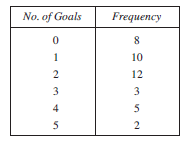
A football team keep records of the number of goals it scores per match during a season. The list is shown opposite.
Find the mean number of goals per match.

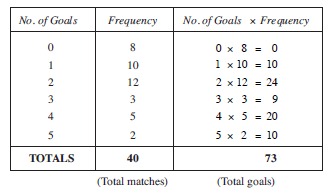
The previous table can be used, with a third column added.
The mean can now be calculated.
| Mean | = |
| = 1.825 |
The bar chart shows how many cars were sold by a salesman over a period of time.
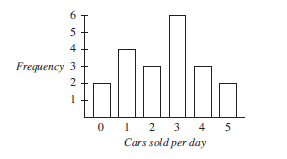
Find the mean number of cars sold per day.
The data can be transferred to a table and a third column included as shown.
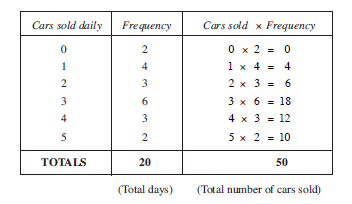
| Mean | = |
| = 2.5 cars |
A police station kept records of the number of road traffic accidents in their area each day for 100 days. The figures below give the number of accidents per day.
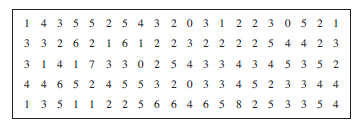
Find the mean number of accidents per day.
The first step is to draw out and complete a tally chart. The final column shown below can then be added and completed.
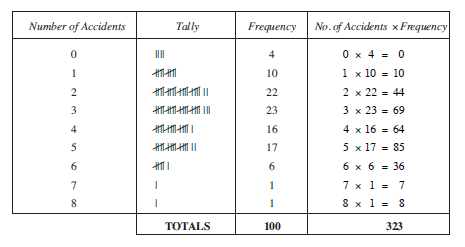
Mean number of accidents per day = = 3.23
The marks obtained by 25 pupils on a test are shown below.
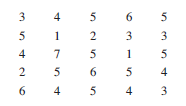
Copy and complete the frequency table below to present the information given above.
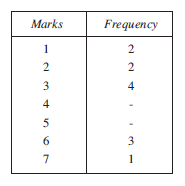
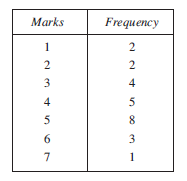
(Check: total frequency = 2 + 2 + 4 + 5 + 8 + 3 + 1 = 25)
Using the frequency distribution, state
the modal mark
Modal mark = 5 (with frequency 8)
the median mark
Median mark = 4 (as we need the 13th number, when in order)
the range.
Range = 7 − 1 = 6
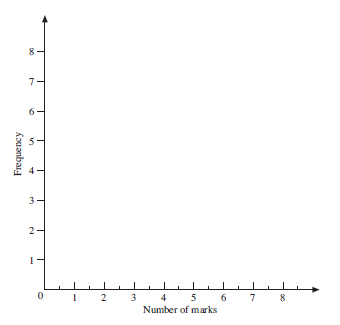
On graph paper, draw a histogram to illustrate the frequency distribution. Use axes as labelled below.
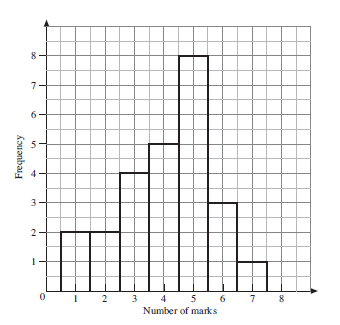
A pupil is chosen at random from the group of pupils. What is the probability that the pupil's mark is greater than 5 ?
p(mark greater than 5) = = = 0.16
Information
The study of statistics was begun by an English mathematician, John Graunt (1620–1674). He collected and studied the death records in various cities in Britain and, despite the fact that people die randomly, he was fascinated by the patterns he found.
Exercises
