

Inequalities involving x2 rather than x can still be solved. For example, the inequality
x2 < 9
will be satisfied by any number between −3 and 3. So the solution is written as
−3 < x < 3
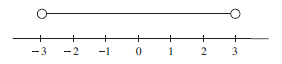
If the inequality had been x2 > 9, then it would be satisfied if x was greater than 3 or if x was less than −3. So the solution will be
x > 3 or x < −3
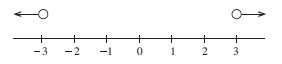
The end points of the intervals are defined as = ±3.
Note
For this type of inequality it is very easy to find the end points but care must be taken when deciding whether it is the region between the points or the region outside the points which is required. Testing a point in a region will confirm whether your answer is correct.
For example, for x2 > 9, test x = 2, which gives 4 > 9. This is not true, so the region between the points is the wrong region; the region outside the points is needed.
Worked Examples
Show on a number line the solutions to:
x2 ≥ 16

The solution to x2 ≥ 16 is
x ≤ −4 or x ≥ 4
which is shown below.

x2 < 25
The solution of x2 < 25 is
−5 < x < 5
which is shown below.

Find the solutions of the inequalities
x2 + 6 > 15
By subtracting 6 from both sides, the inequality
x2 + 6 > 15
becomes
x2 > 9
Then the solution is
x < −3 or x > 3
3x2 − 7 ≤ 41
Begin with the inequality
3x2 − 7 ≤ 41
Adding 7 to both sides gives
3x2 ≤ 48
Dividing both sides by 3 gives
x2 ≤ 16
Then the solution is
−4 ≤ x ≤ 4
Solve the inequality
x2 − 3x − 4 > 0
The left-hand side of the inequality can be factorised to give
(x − 4)(x + 1) > 0
The inequality will be equal to 0 when x = 4 and x = −1. This gives the end points of the region as x = 4 and x = −1, as shown below.

Points in each region can now be tested.
| x = 2 | gives | −2 × 3 > 0 | or | −6 > 0 | This is not true. |
| x = −2 | gives | −6 × −1 > 0 | or | 6 > 0 | This is true. |
| x = 5 | gives | 1 × 6 > 0 | or | 6 > 0. | This is true. |
So the inequality is satisfied for values of x greater than 4, or for values of x less than −1. This gives the solution
x < −1 or x > 4

Exercises
