

A protractor and a compass can be used to produce accurate drawings of triangles and other shapes.
We first recap some basic constructions that you will have met before.
Worked Examples

Construct the perpendicular bisector of the line AB.
Then label the midpoint of AB, M.

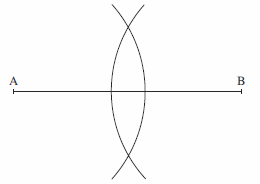
There are many lines that cut AB exactly in half. We have to construct the one that is perpendicular to AB.
We begin by drawing arcs of equal radius, centred on the points A and B, as shown in the diagram.
The radius of these arcs should be roughly to of the length AB.
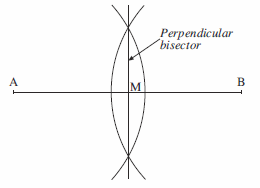
Then draw a line through the intersection points of the two arcs.
The point where the bisector intersects AB can then be labelled M.
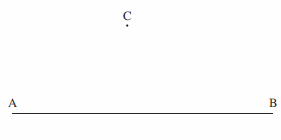
The diagram shows the line AB and the point C.
Draw a line through C that is perpendicular to AB.
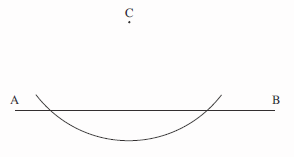
Using C as the centre, draw an arc as shown.
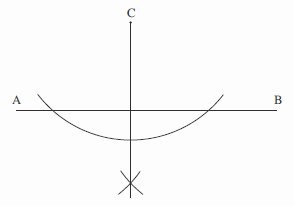
Then using the intersection points of this arc with the line AB as centres, draw two further arcs with radii of equal length. The perpendicular line can then be drawn from C through the point where these two new arcs cross.
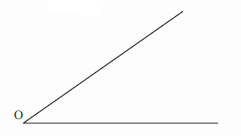
Bisect this angle.
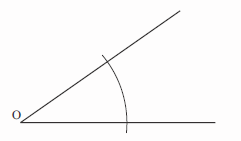
To bisect an angle you need to draw a line that cuts the angle in half.
First draw an arc using O as the centre.
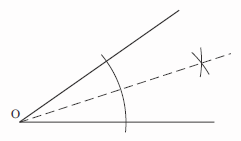
Then draw two further arcs of equal radius, using the points where the arc intersects the lines as the centres.
The bisector can then be drawn from O through the point where these two new arcs cross.
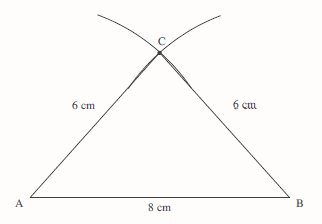
Construct a triangle with sides of length 8 cm, 6 cm and 6 cm.
First draw a line of length 8 cm.
Then set the distance between the point and pencil of your compass to 6 cm and draw an arc with centre A as shown below.
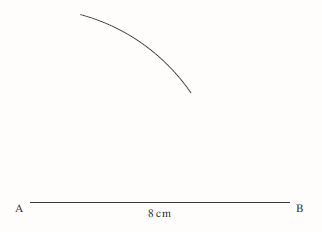
The arc is a distance of 6 cm from A.
With your compass set so that the distance between the point and the pencil is still 6 cm, draw an arc centred at B, as shown below.
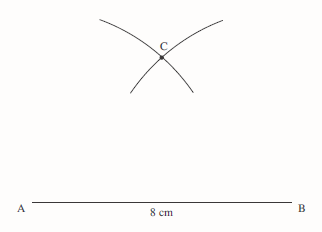
The point, C, where the two arcs intersect is the third vertex of the triangle.
The triangle can now be completed.
The diagram shows a rough sketch of a triangle.
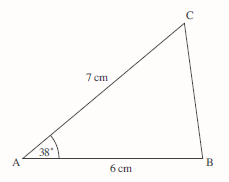
Make an accurate drawing of the triangle, using a ruler and protractor, and find the length of the third side.
First draw a line of length 6 cm and measure an angle of 38°.
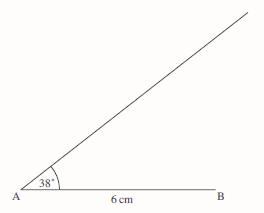
Then measure 7 cm along the line and the triangle can be completed.
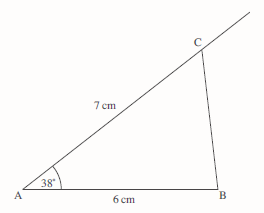
The third side of the triangle can then be measured as approximately 4.3 cm.
Draw a line segment, PQ, 7 cm long.

Using only a ruler, a pencil and a pair of compasses, construct a line segment, LM, the perpendicular bisector of PQ, such that
LM cuts PQ at O, and OL = OM = 4 cm.
With compass centre P and centre Q and radius, say 7 cm, draw circle segments. The points of intersection form the perpendicular to PQ, crossing at point O. Use a ruler to find points L and M on this line.
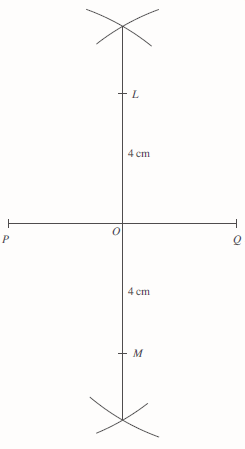
Form parallelogram PLQM by joining the points P, L, Q and M.

Measure and state the size of the angle MPL.
Angle MPL ≈ 98°
What type of parallelogram is PLQM? Give a reason for your answer.
PLQM is a rhombus as all sides are equal and angles are not equal to 90°.
The diagram shows a rough sketch of a triangle.
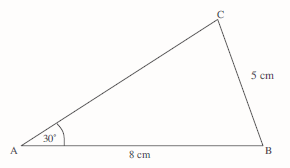
Make an accurate drawing of the triangle.
What is the length AC?
First draw the side of length 8 cm and measure the angle of 30°, using a protractor, as shown below.
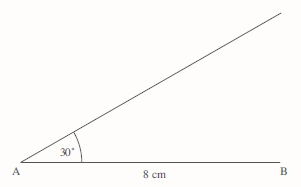
[ Alternatively, you can construct an angle of 60° and then bisect it to obtain an angle of 30°.
To construct an angle of 60°:
Draw the line AB of length 8 cm.
Using compasses, draw a sector of the circle, centre A, radius 8 cm, as shown below.
With your compass point placed at point B, mark off the intersection of this circle with a second circle of radius 8 cm, centre B. Call this point P.
Join A to P. Angle PAB is 60°.
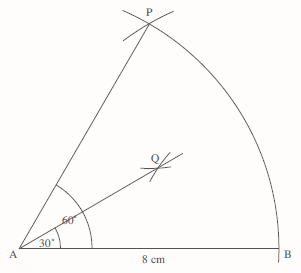
You can obtain an angle of 30° by bisecting angle PAB in the usual way (see diagram), by drawing sectors of circles, radii approximately 4.5 cm, centred on points P and B, marking the point of intersection as Q.
Join A to Q. Angle QAB is 30°.]
Set the distance between the point and pencil of your compass to 5 cm.
Then draw an arc centred at B, which crosses the line at 30° to AB.
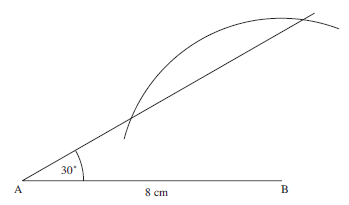
As the arc crosses the line in two places, there are two possible triangles that can be constructed as shown below.
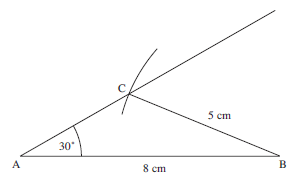
Both triangles have the lengths and angle specified in the rough sketch.
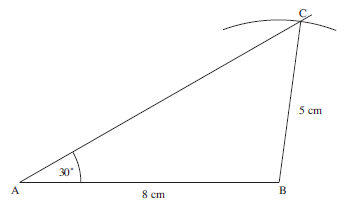
The possible lengths of AC are, approximately, 3.5 cm and 9 cm.
Note
An arc must be taken when constructing triangles to ensure that all possibilities are considered.
Exercises
