Text
Unit I2 Section 1
Mixed Problems Using Trigonometry

When you look up at something, such as an aeroplane, the angle between your line of sight and the horizontal is called the angle of elevation.
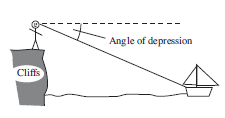
Similarly, if you look down at something, then the angle between your line of sight and the horizontal is called the angle of depression.

Worked Examples

1

A man looks out to sea from a cliff top at a height of 12 metres. He sees a boat that is 150 metres from the cliffs. What is the angle of depression?

The situation can be represented by the triangle shown in the diagram, where θ is the angle of depression.
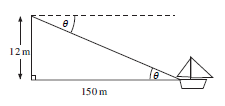
In this triangle,

opposite = 12 m

adjacent = 150 m

Using

tanθ =

gives

tanθ =
= 0.08

Using a calculator gives θ = 4.6° (to 1 d.p.)

2

A person walking on open land can see the top of a radio mast. The person is 200 metres from the mast. The angle of elevation of the top of the mast is 3°. What is the height of the mast?
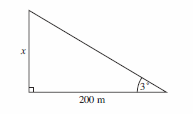
The triangle illustrates the situation described.

In this triangle,

opposite = x

adjacent = 200 m

Using

tanθ =

gives

tan3° =

Multiplying both sides by 200 gives

x = 200 × tan3°
= 10.5 metres (to 1 d.p.)
3

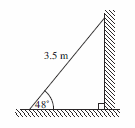
A ladder is 3.5 metres long. It is placed against a vertical wall so that its foot is on horizontal ground and it makes an angle of 48° with the ground.

(a)

Draw a diagram which represents the information given. Label the diagram showing the ladder, the wall and the ground and insert all measurements given.
(b)

Calculate, to two significant figures,

(i)

the height the ladder reaches up the wall

height = 3.5 sin48°
≈ 2.601
= 2.6 m to 2 significant figures
(ii)

the distance the foot of the ladder is from the wall.

distance = 3.5 cos48°
≈ 2.342
2.3 m to 2 significant figures
(c)

The top of the ladder is lowered so that it reaches 1.75 m up the wall, still touching the wall.

Calculate the angle that the ladder now makes with the horizontal.
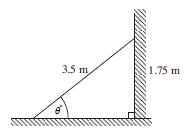
sinθ =
≈ 0.5
θ = 30°

Exercises

Round your answers correct to 2 decimal places when necessary on this page.

In order to find the height of a tree, some students walk 50 metres from the base of the tree and measure the angle of elevation as 10°. Find the height of the tree.

m

From a distance of 20 metres from its base, the angle of elevation of the top of a pylon is 32°. Find the height of the pylon.

m

The height of a church tower is 15 metres. A man looks at the tower from a distance of 120 metres. What is the angle of elevation of the top of the tower from the man?

°

A lighthouse is 20 metres high. A life-raft is drifting and one of its occupants estimates the angle of elevation of the top of the lighthouse as 3°.

(a)

Use the estimated angle to find the distance of the life-raft from the lighthouse.

m (to 1 d.p.)
(b)

If the life-raft is in fact 600 metres from the lighthouse, find the correct angle of elevation.

°

A man stands at a distance of 8 metres from a lamppost. When standing as shown, he measures the angle of elevation as 34°. Find the height of the lamppost.

m

From his hotel window a tourist has a clear view of a clock tower. The window is 5 metres above ground level. The angle of depression of the bottom of the tower is 5° and the angle of elevation of the top of the tower is 7° .

(a)

How far is the hotel from the tower?

m
(b)

What is the height of the tower?

m

A radar operator notes that an aeroplane is at a distance of 2000 metres and at a height of 800 metres. Find the angle of elevation. A little while later the distance has reduced to 1200 metres, but the height remains 800 metres. How far has the aeroplane moved?

Angle of elevation: °

The aeroplane moved: m (to 1 d.p.)

The diagram represents a triangular roof frame ABC with a window frame EFC. BDC and EF are horizontal and AD and FC are vertical.

(a)

Calculate the height AD.

m
(b)

Calculate the size of the angle marked x° in the diagram.

° (to 1 d.p.)
(c)

Calculate FC.

m