

A translation moves all the points of an object in the same direction and the same distance. The diagram shows a translation.
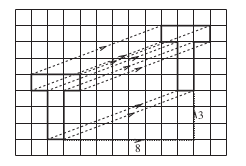
Here every point has been moved 8 units to the right and 3 units up.
This translation is described by what is called a vector
Further work on vectors is in Strand J, Unit J3.
Worked Examples
Describe the translation which moves the shaded shape to each of the other shapes shown.
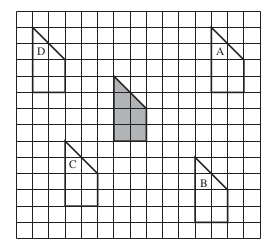

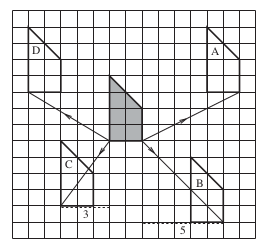
To move to A, the shaded shape is moved 6 units to the right (horizontally) and 3 units up (vertically).
This is described by the vector .
To obtain B, the shaded shape is moved 5 units to the right and 5 units down.
This is described by the vector .
To obtain C, the shaded shape is moved 3 units to the left and 4 units down.
This is described by the vector .
To obtain D, the shaded shape is moved 5 units to the left and then 3 units up.
This is described by the vector .
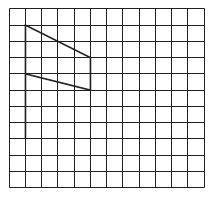
The shape shown in the diagram is to be translated using
the vector .
Draw the image obtained using this translation.
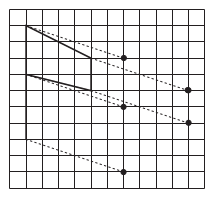
The vector describes a translation which moves an object 6 units to the right and 2 units down. This translation can be applied to each point of the original.
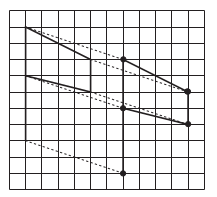
The points can then be joined to give the translated image.
Exercises

Challenge!
1. By moving only one coin in the pattern shown, make one row and one column, each containing 5 coins.
2. Rearrange the 8 coins to form a square with 3 coins on each side. By rearranging 4 coins, make a square with 4 coins on each side.