On
the
Side
Looking For Patterns
You can read more about this incident in the wonderful book by Edward R. Tufte, 'Visual Explanations'.
Introduction
The text on this page in a form suitable for
copying and pasting.
Activities
An
Unusual Incident

What was
this unusual incident?
Weather
Data for Australian Capital Cities
Weather
Data for Queensland Towns
For Your
Information
The
Six Characteristics of a Dataset
The link between O-ring damage and ambient temperature had been established prior to the flight. The engineers at Morton Thiokol, Inc had recommended that the flight be delayed, but they failed to display the link between ambient temperature and O-ring damage in a clear and unambiguous fashion to those making the final decision. The launch proceeded with disastrous consequences.
A simple scatterplot showing the link between O-ring damage and ambient temperature during previous launches may have changed the decision about launching. How much damage would you have expected at 0 0 Celsius?
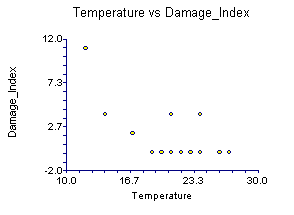
adapted from: Tufte, E.R., Visual Explanations
An Unusual Incident
High school textbooks often start a unit on statistics with the calculation of the mean of a set of numbers (usually made up, and put into a trivial setting, but that is a different issue). For a number of reasons, that is the wrong place to start an analysis of data. And it certainly isn’t what a statistician does.
After gathering data, statisticians like to look at the data in as many ways as possible. Any unusual or interesting patterns in the data should be flagged for further investigation. An Unusual Incident is an engaging activity to introduce a unit on statistics. Students are asked to discover the many intriguing patterns in the data and hence to deduce what was the incident.
Weather Data for Capital Cities
Weather Data for
Queensland Towns
These are follow-up activities to An Unusual Incident. Students are asked to match each city or town with its climate chart. For each location the mean monthly maximum and minimum temperatures and the median monthly rainfall are given in graphical form. The Queensland Towns activity also contains the original data in table format. Due to the large number of graphics these activities are only available as Word 2.0 documents.
The Six Characteristics of a Dataset
What does a student actually look for when they are asked to 'view' a dataset? The article on The Six Characteristics of a Dataset (shape, location, spread, outliers, clustering and granularity) discusses a useful starter set of features.
| Read
Me First! | Introduction | Acknowledgements |
| Looking
for Patterns |Stemplots | Dotplots | Histograms |
| Measures
of Location | Measures of Spread |
| Boxplots | Normal
Plots
| Scatterplots |
|
Assessment | Datasets | Resources |
| VISITOR'S
BOOK
| SEARCH | HOME |
| Linear Regression | Normal
Distribution |
| Probability | Sampling | Confidence
Intervals |
| Hypothesis Testing | Non
Linear Regression |